
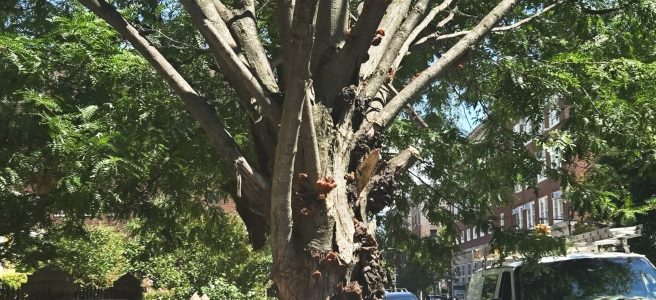
Dark orange ear-shaped mushrooms recently appeared on a small sidewalk tree in my neighborhood. Failing to grow, the tree has now missed its blooming cycle for two consecutive summers. This summer’s weather, in New York City, has been marked by heat and high humidity. Higher-than-average precipitation has even resulted in flash flooding. Sudden appearance of mushrooms is an indication of rot and decay inside the tree. While heavy rains combined with extended periods of high heat and humidity can trigger rapid mushroom growth, and although their appearance seems spontaneous, an internal fungal network has been growing inside the tree for several months to years.
Mushrooms are the spore forming fruit of a larger hidden body of thread-like mycelium. In most instances mushrooms decompose dead wood, indicating that the tree is dead. By the time you see mushrooms, the tree has been rotting from the inside out. As a result, trees covered in mushrooms are structurally compromised and at risk of falling. Public trees in NYC are governed by the NYC Department of Park and Recreation and dead trees should be reported for removal using the interactive NYC Tree Map or by calling 311.
The “root-cause” of why the tree died is not certain but there are some clues…
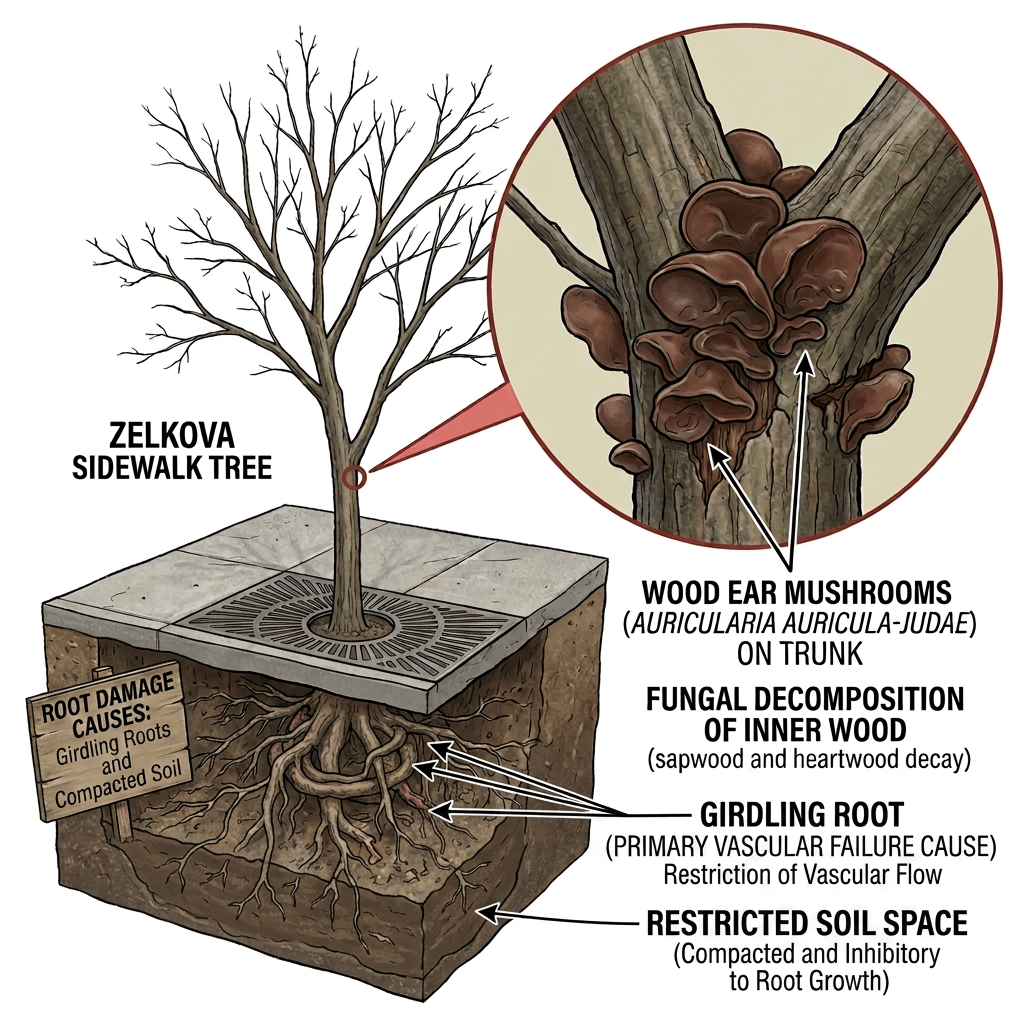
Japanese Zelkova
Using the Park Service’s map, I was able to identify the tree as a Japanese Zelkova (Zelkova serrata), also known as Keyaki or Keaki. Native to Japan and other parts of Asia, like Korea and Taiwan, Japanese Zelkova were introduced to America in 1862 Due to their ability to grow in acidic, alkaline, moist, and arid soil they have been considered good for street planting or what is known as urban greening. Japanese Zelkova are reportedly effective in purifying urban air due to their canopy of leaves which absorb carbon dioxide (CO2) and capture particulate matter (black carbon and dust) present in ambient and traffic related air pollution. Trees, in general, function as biofilters, mitigating vehicular emissions and improving air quality. The Zelkova in my neighborhood has been standing since at least 2017 and although not a large trees, it is reported as having annually intercepted 346 gallons of storm water and removed one pound of air pollutants.
Zelkova’s are deciduous hardwood trees that prefer full sun and are capable of surviving urban environmental stress, such as high temperatures, low humidity, drought, and soil limitation. In cities, trees often have limited space for their roots and may experience water stress. Although one of many trees on my block, the Zelkova enjoyed unincumbered sunlight being a good distance from others. Relatively young, this Zelkova would not have undergone considerable pruning, where incorrect pruning could have hindered spring foliage or trunk damage could allow fungal spores to enter. Deciduous trees shed their leaves annually, during autumn in preparation for winter. While freezing weather, like what occurred this winter in NYC this year, can cause dieback in which branches fail to produce foliage, the previous year was comparatively mild yet the tree produced not one leaf. Neither budding nor blooming, the Zelkova remained relatively small and leafless for two consecutive summers despite previous normal flourishing. Trees that have stalled in overall growth and fail to produce foliage likely have incurred long-term nutrient deficiencies from water conductivity failure indicating a problem with the roots.
Root of the Matter
Roots play a significant role in water uptake which affects photosynthesis and carbon dioxide (CO2) absorption. Normal Zelkova root hydraulics efficiently balances water uptake with carbon gain which affects overall growth. Root girdling can occur in trees planted in narrow sidewalk cutouts, where the roots eventually run out of room and start circling the trunk below the surface. This causes vascular compression and failure, as both the trunk and roots expand in diameter. Compression deforms internal xylem tissue and phloem bark gradually choking off water (hydraulic failure) and nutrient absorption (nutrient starvation). The result is stunted foliage and branch death. Xylem are the specialized transport tissue that moves water and dissolved minerals upward from the roots, comprising what we know as wood. Phloem is the living inner bark of the tree that carries carbohydrates and sugars made in the leaves to the rest of the tree. Therefore, uptake and transport throughout the tree would be compromised. Deep planting, compacted soil, and salt injury could also contribute to root problems and canopy loss.
Wood Ear Fungi
Mushrooms are heterotrophic eukaryotic organisms. Heterotrophs cannot make their own food and must get energy from other plants, animals or organic matter. Therefore, mushrooms form various types of relationships with the trees they grow in order to derive the nutrients they need. Saprotrophic mushrooms feed on dying trees and deadwood, secreting digestive enzymes that decompose wood into cellulose (a polysaccharide) and lignans (polyphenols). Mycorrhizal mushrooms form mutualistic relationships, providing water and minerals to trees while the tree in turn provides sugars. Parasitic mushrooms infect and feed on healthy living trees, harming and potentially killing them.
The mushrooms growing on the tree are orange ear-shaped and clustered with some having turned black. They are likely Wood Ear fungi (Auricularia sp.), which darken as they dry and age and are known to grow on dead hardwood trees making them saprotrophs. The location of the mushrooms can also be informative, with mushrooms at the base and roots of a tree indicative of root or butt rot, while mushrooms on the trunk informs of heartwood decay (heartwood is the central wood of the tree). Mushrooms on branches are not always a sign of disease or death as it can be common and may only require pruning of the affected branch. The mushrooms on the Zelkova on my sidewalk are located high on the trunk of the tree, near the start of the branches, with a few extending upward. This is another clue that points to vascular/root dysfunction, also suggesting that the development of fungi/mushrooms are a symptom of an underlying problem and not the original cause of death. Mushrooms emerging around the juncture of major branches also indicates significant internal decay as in most cases fungi decompose wood tissue.
Mushrooms can also be categorized as edible or inedible. Various species of Wood Ear fungi are used as a food ingredient, particularly in Asian cuisines. Although belonging to different families, other saprotrophic mushrooms that grow on hardwood trees like Shiitake, Turkey tail, Oyster, and Reishi are also edible and said to have medicinal properties. While these mushrooms can be nutritious and have beneficial properties (anti-inflammatory/antioxidant, lipid-lowering, and antitumor), scavenging urban mushrooms from a sidewalk tree is not recommended. Cultivated mushrooms that have been grown in a controlled environment avoids contamination that can occur from traffic-related pollution and other side-walk city activity.
City Contamination
Since mushrooms play a role in environmental element cycling, transforming organic and inorganic matter into minerals, they can absorb and accumulate metals and pollutants from the surrounding microenvironment. Mushrooms can contain an excess amount of heavy metals like cadmium (Cd), lead (Pb), arsenic (As), and mercury (Hg) due to the abundant presence of metallothionein in mushrooms. Metallothionein binds heavy metals causing them to accumulate in mushrooms. Accumulation varies by species and location, and cultivated mushrooms show lower accumulation of toxic metals than those associated with urban sites. While fungal species growing on wood generally contain lower concentrations of metals than fungi growing in soil, the main uptake route of these toxic metals is by means of absorption from soil through the vascular/root system.
Soil around city street trees were found to have increased salinity and alkalinity which affected micronutrients. Road salting is primarily responsible for higher amounts of nutrients like sodium (Na), Chloride (Cl), Calcium (Ca), Zinc (Zn), and Copper (Cu) in sidewalk trees, which were also found to have higher pH and lower potassium (K) and magnesium (Mg). Consequently, increased soil salinity can also lead to poorer foliage (leaf production not folate). Other factors influencing nutrient uptake from soil are the pH, carbon to nitrogen ratio, moisture, soil temperature, climate, and other street-associated factors. Urban soil can also have poor aeration due to compaction and low organic matter content which normally buffers the absorption of traffic-related pollutants into soil. Without leave and ground level organic matter to mitigate pollution, increased deposition of heavy metals can occur. Sidewalk soil has been found to be contaminated with cadmium, lead, zinc, and copper with their deposition also influenced by distance from the road, proximity to a highway, parking area, and density of traffic. Even at low concentration, chronic deposition can lead to gradual accumulation in urban environments. These factors can impact soil quality, affecting root and tree vitality and accumulation in subsequent mushroom growth.
While zinc and copper are essential trace elements that are safe and necessary at low-levels, cadmium and lead are non-essential metals with no known biological benefits in humans. Toxic metals have been associated with cardiovascular and respiratory diseases, neurological disorders, chronic inflammation, and cancers. Other organic roadside soil contaminants include PAHs (polycyclic aromatic hydrocarbons) and TPH (total petroleum hydrocarbons). PAHs can originate from pyrogenic (burning coal, oil, gas, wood, or tobacco) or petrogenic (petroleum) sources, and consist of fused benzene ring structures that can be highly toxic. Other petroleum hydrocarbons classified as TPH include aliphatic (chains/non aromatic rings) compounds. Urban environments are notoriously affected by pollution from traffic and industrial activities which can have adverse consequences for both urban ecosystems and human health. Particularly, bioaccumulation from soil to trees and mushrooms to humans can intensify the bioavailability of harmful substances through diet. So, think twice and avoid snacking on roadside mushrooms even if they are growing freely on a city tree.
Connecting the Dots
Ultimately, the Wood Ear mushrooms growing on the Japanese Zelkova are less a cause of its decline than a visible indication of a much longer process of decay occurring beneath the bark and below the sidewalk. Although the exact root-cause of its death is uncertain, restricted roots, compacted and contaminated soil, road salt, and other urban stresses may have impaired the trees ability to transport water and nutrients, weakening it over-time. By the time the orange, ear-shaped mushrooms appeared, the tree had already failed to produce leaves for two consecutive summers, suggesting that its internal systems had been compromised for some time. This summer’s combination of heavy rainfall, high humidity, and extreme heat likely provided ideal conditions for the rapid growth of the fungi, making an existing problem suddenly visible. The mushrooms therefore are not necessarily what killed the tree, but a sign that the tree was already dead or dying and that its remaining wood is now being returned to the environment. both trees and mushrooms are key components of urban ecosystems that act simultaneously as recipients and mitigators of environmental pollution. displayed on my block, a dead tree and the mushrooms growing on it acting as nature’s recycling system, turning dead things into new life.
References
- Manici, L. M., De Meo, I., Saccà, M. L., Ceotto, E., Caputo, F., & Paletto, A. (2023). The relationship between tree species and wood colonising fungi and fungal interactions influences wood degradation. Ecological Indicators, 151, 110312. https://doi.org/10.1016/j.ecolind.2023.110312
- Qin, G., Liu, J., Zou, K., et al. (2024). Analysis of heavy metal characteristics and health risks of edible mushrooms in the mid-western region of China. Scientific Reports, 14, 26960. https://doi.org/10.1038/s41598-024-78091-1
- Schlecht, M. T., & Säumel, I. (2015). Wild growing mushrooms for the edible city? Cadmium and lead content in edible mushrooms harvested within the urban agglomeration of Berlin, Germany. Environmental Pollution, 204, 298–305. https://doi.org/10.1016/j.envpol.2015.05.018
- Singh, R., Chavan, S. B., Tomar, A., et al. (2025). Species variation in air pollution tolerance, performance, and dust retention of urban roadside trees: Implications for urban greening and green corridor planning. Air Quality, Atmosphere & Health, 18, 3311–3327. https://doi.org/10.1007/s11869-025-01841-1
- Taneda, & Ikeda. (2021).Hydraulic architecture with high root-resistance fraction contributes to efficient carbon gain of plants in temperate habitats. American Journal of Botany, 108(10), 1932–1945. https://doi.org/10.1002/ajb2.1753
- Tedoldi, D., Charafeddine, R., Branchu, P., Thomas, E., & Gromaire, M.-C. (2021). Intra- and inter-site variability of soil contamination in road shoulders—Implications for maintenance operations. Science of The Total Environment, 769, 144862. https://doi.org/10.1016/j.scitotenv.2020.144862
- Wang, M., & Zhang, H. (2018). Accumulation of heavy metals in roadside soil in urban area and the related impacting factors. International Journal of Environmental Research and Public Health, 15(6), 1064. https://doi.org/10.3390/ijerph15061064
- Taleghani, A., Emami, S. A., & Tayarani-Najaran, Z. (2020). Artemisia: A promising plant for the treatment of cancer. Bioorganic & Medicinal Chemistry, 28(1), 115180. https://doi.org/10.1016/j.bmc.2019.115180
- Raymond Chang, Functional Properties of Edible Mushrooms, Nutrition Reviews, Volume 54, Issue 11, November 1996, Pages S91–S93, https://doi.org/10.1111/j.1753-4887.1996.tb03825.x
- Malvandi H, Parsan H, Gharaei A, Fallahinejad S. (2026). Integrated Assessment of Heavy Metal Accumulation in Urban Trees and Soils and Associated Non-carcinogenic Health Risks in Sabzevar, Iran. Bull Environ Contam Toxicol. Aug 11;117(2):42. doi: 10.1007/s00128-026-04316-w. PMID: 42579006.

